Fraction chart
Fraction Chart
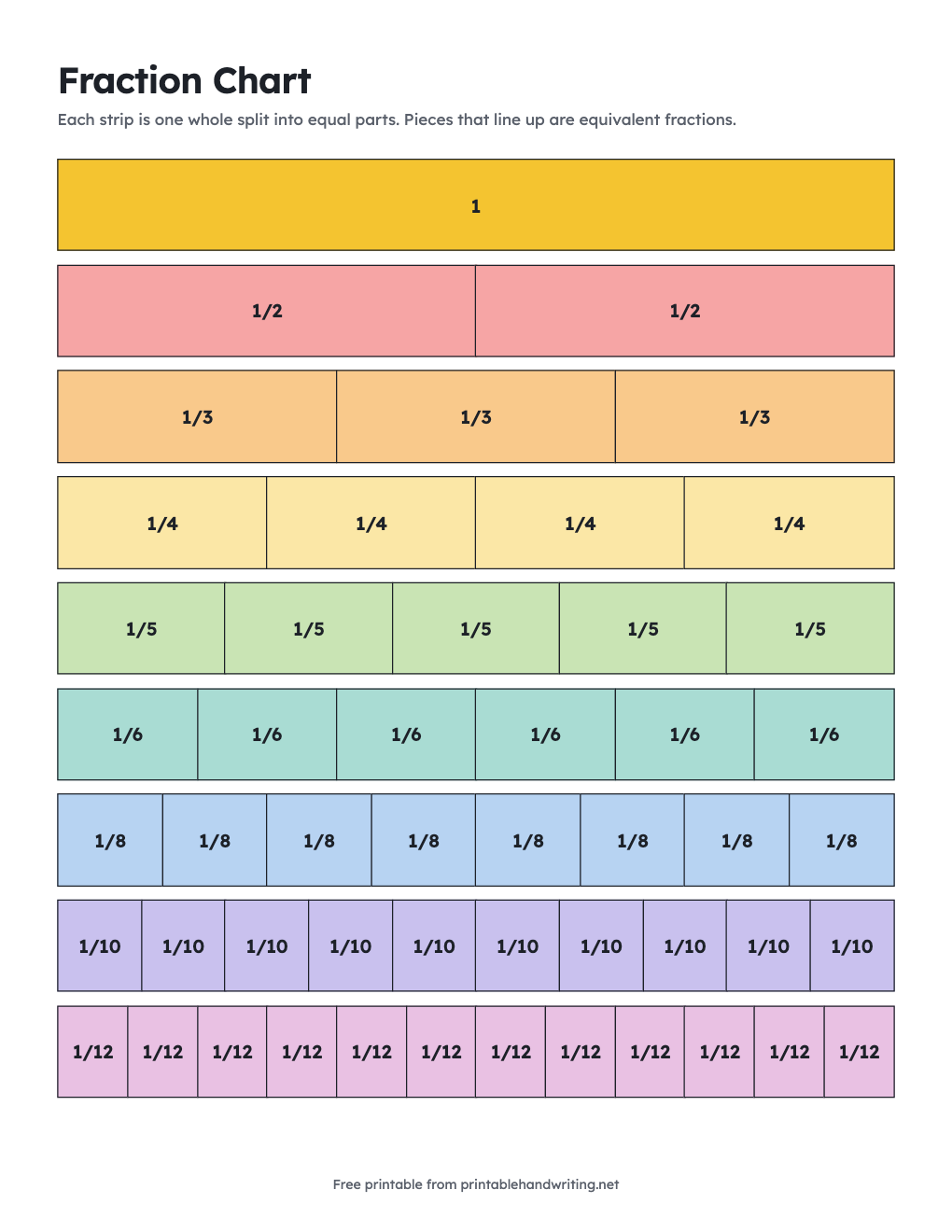
A fraction chart, also called a fraction wall or fraction strips, shows one whole split into halves, thirds, fourths, and smaller equal parts, stacked so they line up. Fractions that end at the same point are equivalent: 3/4, 6/8, and 9/12 all cover the same length. Select a piece below to see its equivalent fractions, decimal, and percent, or print a free fraction chart.
3/4 = 6/8 = 9/12 = 0.75 = 75%
Select a piece to shade that fraction and every equivalent fraction.
How to use a fraction chart
- Find equivalent fractions: pick a fraction and look straight down the chart. Every strip with a piece ending at the same line has an equivalent fraction.
- Compare fractions: the fraction that covers more of its strip is larger. 2/3 reaches past 3/5, so 2/3 is greater.
- See unit fractions shrink: the more pieces a whole is split into, the smaller each one is, so 1/8 is smaller than 1/4 even though 8 is larger than 4.
- Add fractions with like denominators: 1/5 + 2/5 is three fifths laid end to end, 3/5.
Equivalent fractions on the chart
Two fractions are equivalent when they name the same amount. On the chart, 1/2 lines up with 2/4, 3/6, 4/8, 5/10, and 6/12. The same rule works without a chart: multiply or divide the numerator and denominator by the same number, so 1/2 × 3/3 = 3/6.
Some fractions have no match on certain strips. 1/3 lines up with 2/6 and 4/12, but not with any fourths, fifths, eighths, or tenths, because those strips are not split into a multiple of three parts.
Fractions, decimals, and percents
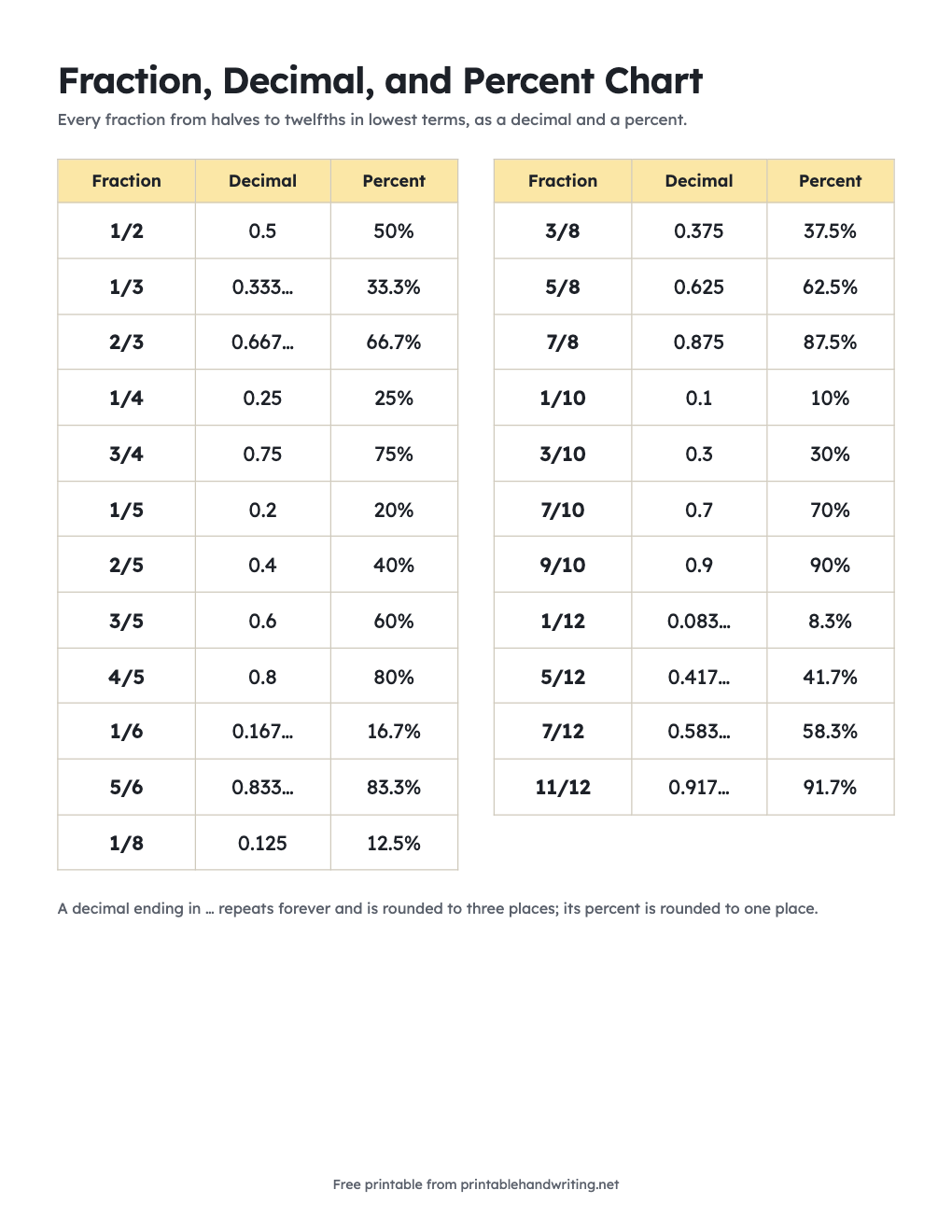
A fraction is also a division: 3/4 means 3 ÷ 4, which is 0.75, or 75 percent. Halves, fourths, fifths, eighths, and tenths give decimals that end. Thirds, sixths, and most twelfths give decimals that repeat forever, such as 1/3 = 0.333…, so they are usually rounded.
In the Common Core standards, students use fraction strips and number lines to understand fractions, including simple equivalent fractions, in third grade (3.NF). Fourth grade extends equivalence and comparison to any fractions and connects tenths and hundredths to decimals (4.NF).
Questions
- Is the fraction chart free to print?
- Yes. Every chart on this page is a free PDF in US Letter or A4, with no account and no watermark. Print it at 100% (actual size) so the grid fits the page.
- What is the difference between a fraction chart and fraction strips?
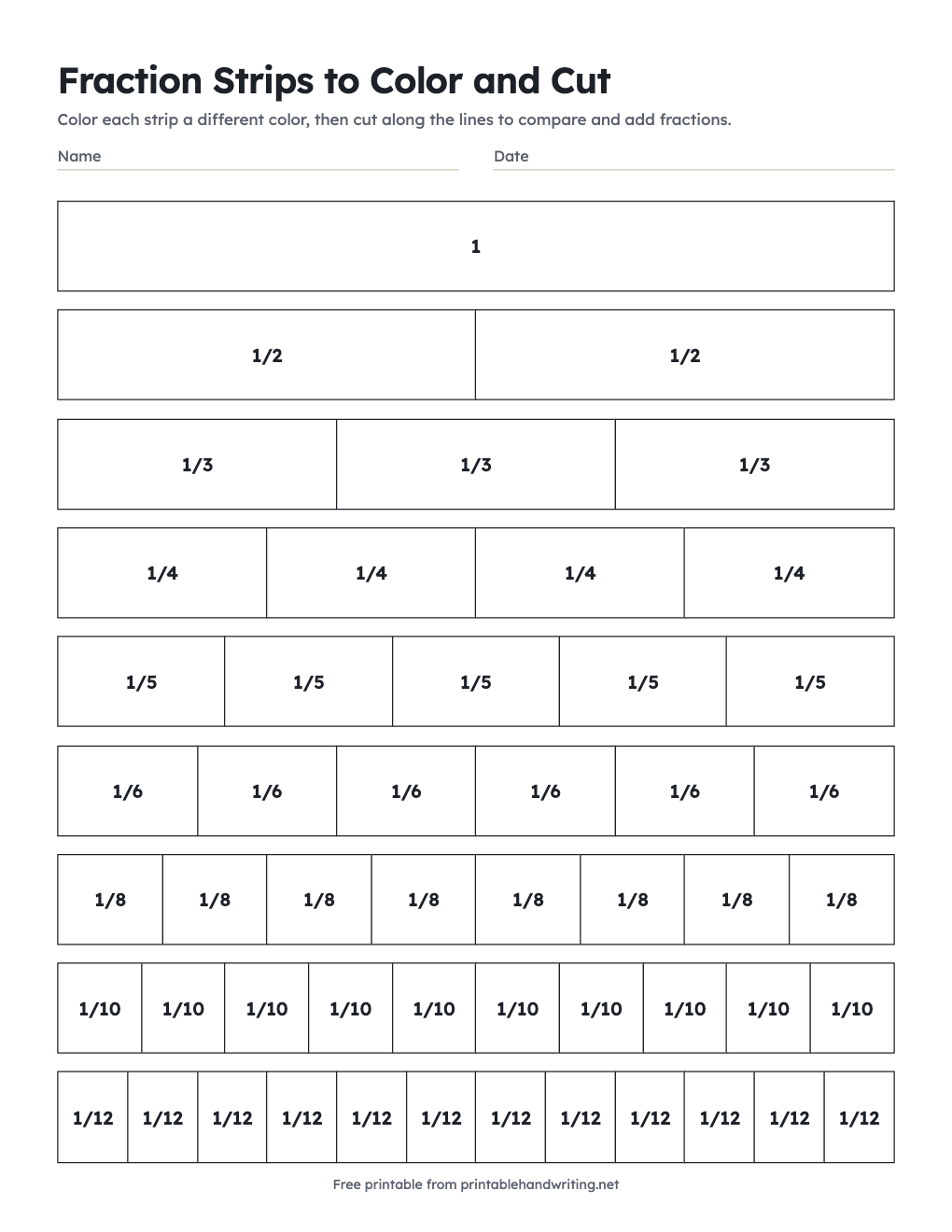
- They are the same idea. Fraction strips are often cut apart so children can move and compare the pieces, while a fraction chart keeps them stacked on one page. The blank strips on this page can be used both ways.
- Why are there no sevenths or ninths?
- The chart uses the denominators taught most in elementary school: halves, thirds, fourths, fifths, sixths, eighths, tenths, and twelfths. Sevenths and ninths rarely line up with the other strips, so they add little to finding equivalent fractions.
- How do I know which fraction is bigger?
- Find both on the chart and see which reaches further to the right. Without a chart, rewrite them with the same denominator: 2/3 = 8/12 and 3/4 = 9/12, so 3/4 is bigger.