Cursive alphabet
Cursive Alphabet A to Z
The cursive alphabet has 26 letters, each with a capital and a lowercase form, so there are 52 shapes to learn. Below, every pair is written in traditional US cursive on three-line handwriting guides. Select a letter to see how it is formed and joined and to print a practice worksheet, or download the whole alphabet as a free chart.
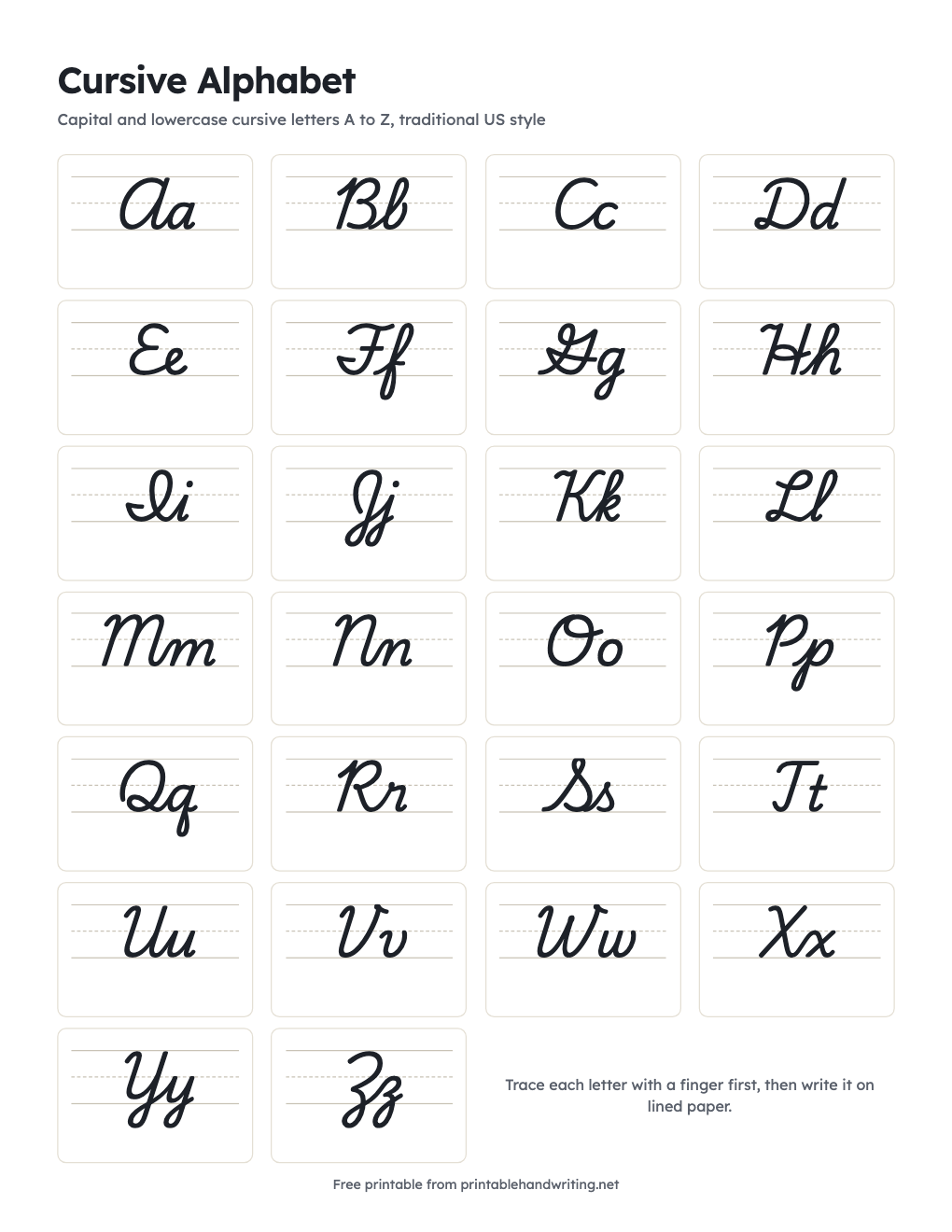
Lowercase cursive letters by stroke family
Most cursive programs teach lowercase letters in groups that start with the same stroke, rather than in alphabetical order. Practicing a family together means the first stroke is rehearsed again with every letter.
| Family | Letters | How they start |
|---|---|---|
| Undercurve | i, t, u, w, r, s, p, j | A stroke that swings up from the baseline to the right. |
| Loop | e, l, h, k, f, b | An undercurve that sweeps up into a loop. |
| Downcurve | a, d, g, o, c, q | A short undercurve, then a curve back down and around to the left, like c. |
| Overcurve | n, m, x, y, z, v | A hump that rises and rolls over to the right. |
Capital cursive letters
Capitals vary more between programs than lowercase letters, and they do not all join the letter after them. In traditional cursive, capitals such as D, F, I, O, P, T, V, and W usually end with a lift, so the next lowercase letter starts fresh, while A, C, E, M, N, U, Y, and Z normally connect. Each letter page notes how its capital joins.
Teach capitals after the lowercase letters are secure: lowercase letters make up most of what a child writes, and several capitals reuse lowercase strokes.
Letters that trip up beginners
- b, o, v, and w end high at the midline, so the next letter is reached with a bridge stroke instead of an undercurve from the baseline.
- f closes its lower loop on the right at the baseline, while g, j, and y close on the left.
- r and s look different in cursive than in print, so children often fall back to the printed shape.
- q and g share a start; the tail is what separates them: the q loop closes on the right and exits with an undercurve, while the g loop closes on the left and exits with an overcurve.
How to practice the cursive alphabet
- Trace one stroke family at a time with a finger, saying the strokes aloud.
- Trace each letter on handwriting lines, then write it three times on your own.
- Join the new letter to ones already learned in short words, since joining is what cursive is for.
- Add capitals once the lowercase family is fluent, starting with the ones that join.
Keep practicing
Questions
- Is the cursive alphabet chart free?
- Yes. Every chart on this page is a free PDF in US Letter or A4, with no account and no watermark. Print it at 100% (actual size) so the grid fits the page.
- Is cursive written the same way everywhere?
- No. The letters here follow traditional US cursive, with looped ascenders and descenders. Programs such as D’Nealian and Zaner-Bloser shape some letters differently, especially a few capitals, so follow the style your school uses.
- Should children learn capital or lowercase cursive letters first?
- Lowercase first. Lowercase letters appear far more often in words, and most programs teach them in stroke families before introducing capitals.
- How many letters are in the cursive alphabet?
- The same 26 letters as print. Each has a capital and a lowercase form, so the chart shows 52 letter shapes.