Place value chart
Place Value Chart
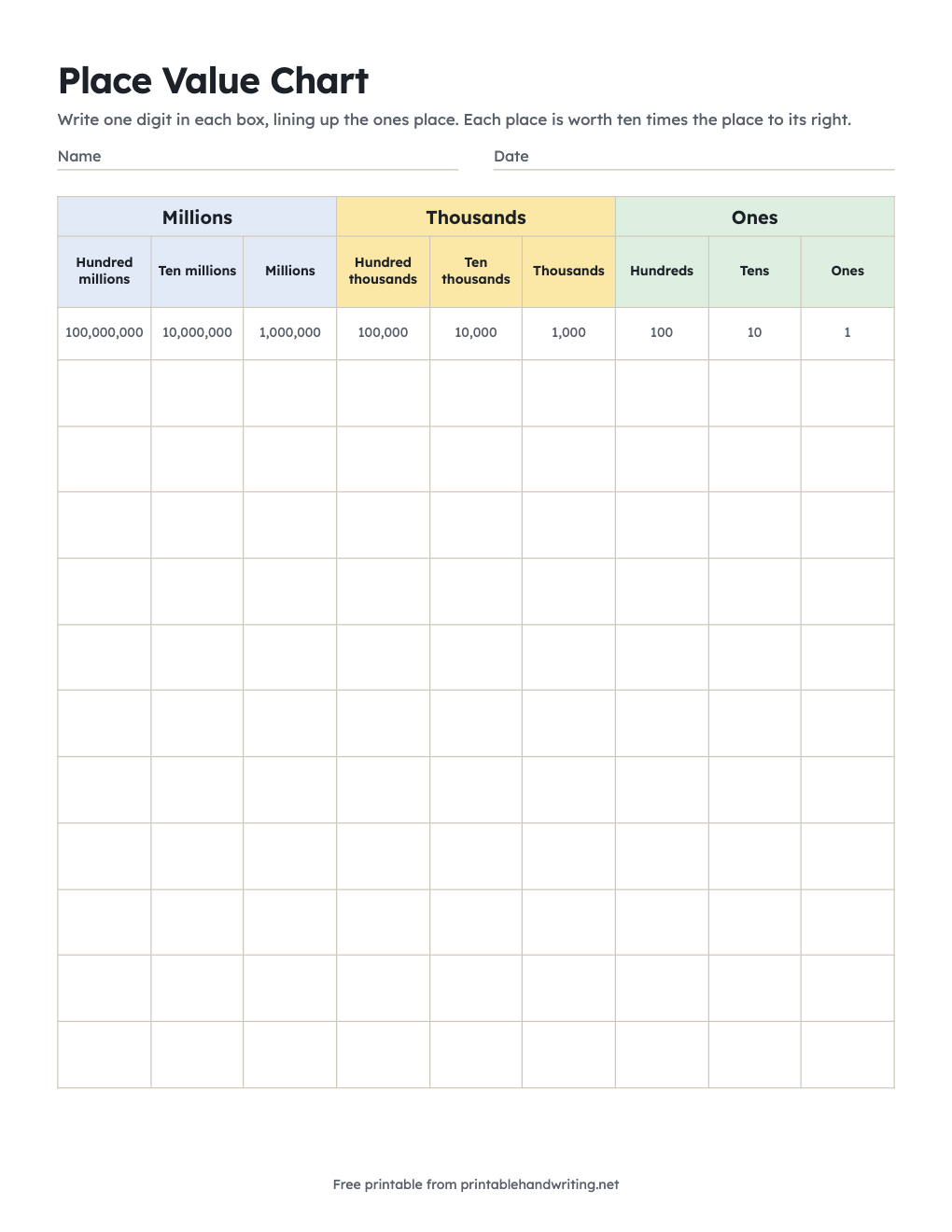
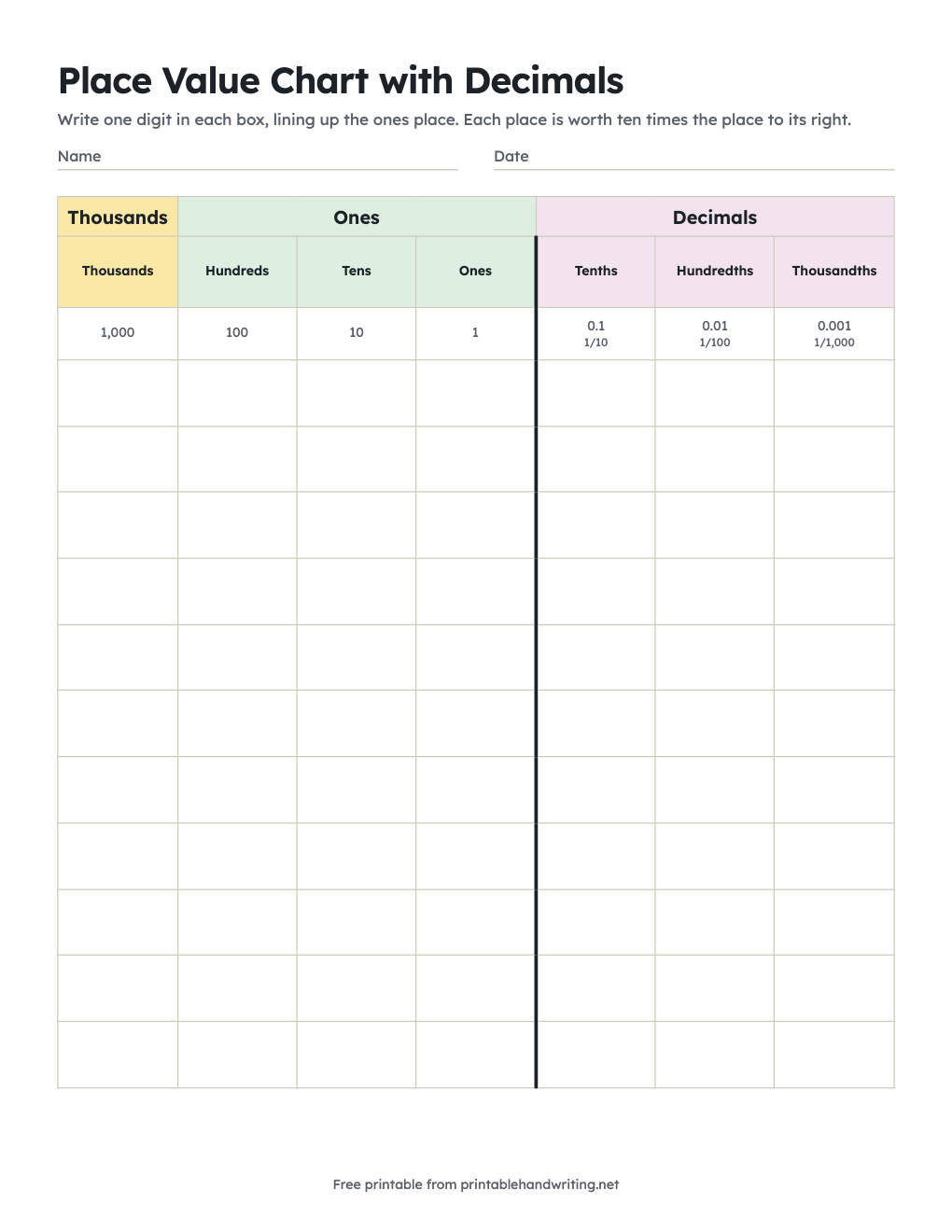
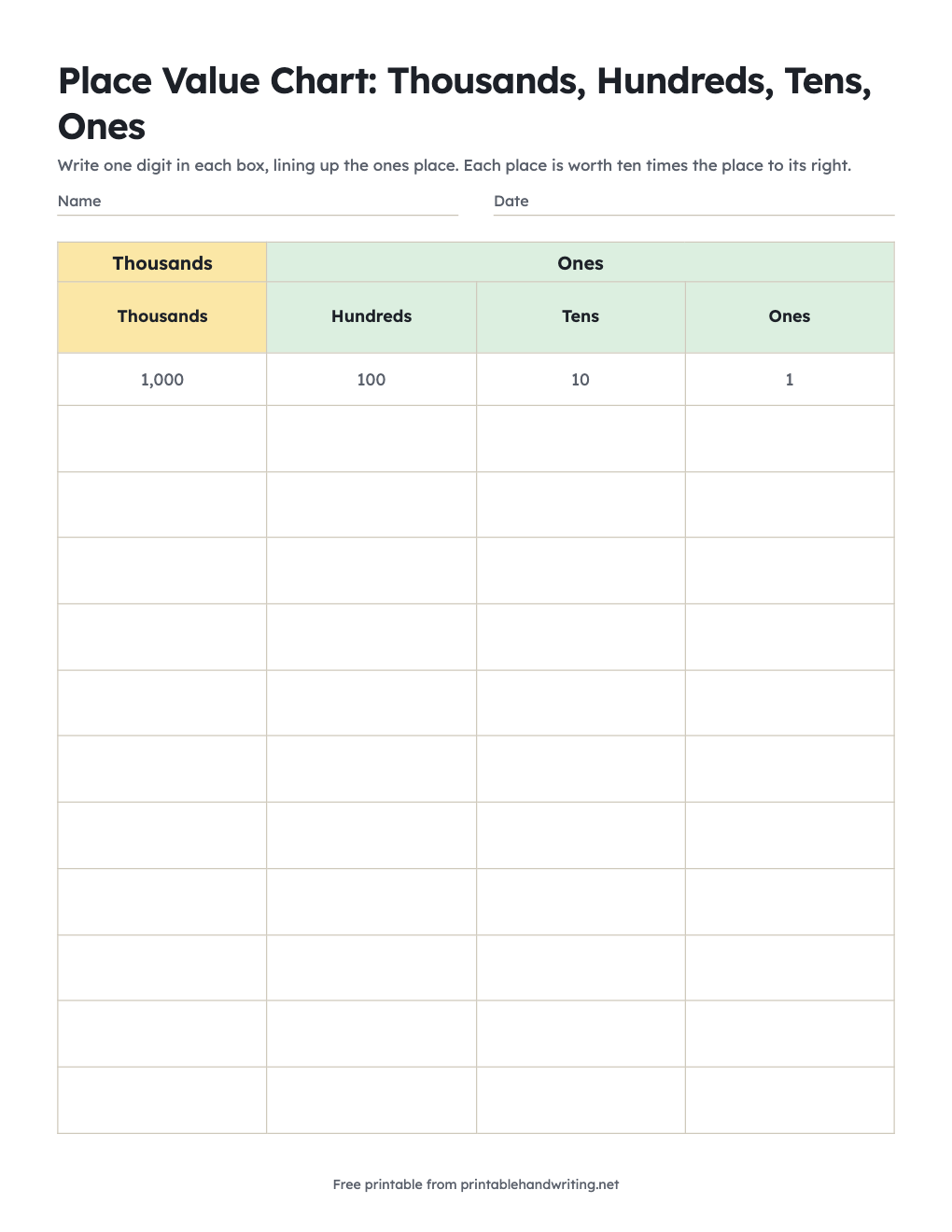
A place value chart shows what each digit in a number is worth, based on its position. Every place is worth ten times the place to its right: ones, tens, hundreds, then thousands, ten thousands, and so on. Type a number below to place its digits on the chart and see its expanded form and word form, or print a free place value chart to millions, to thousands, or with decimals.
Whole numbers up to 999,999,999, with up to three decimal places.
| Millions | Thousands | Ones | Decimals | ||||||||
|---|---|---|---|---|---|---|---|---|---|---|---|
| Hundred millions | Ten millions | Millions | Hundred thousands | Ten thousands | Thousands | Hundreds | Tens | Ones | Tenths | Hundredths | Thousandths |
| 4 | 5 | 8 | 2 | 3 | 1 | 7 | 2 | 5 | |||
- Standard form
- 4,582,317.25
- Expanded form
- 4,000,000 + 500,000 + 80,000 + 2,000 + 300 + 10 + 7 + 0.2 + 0.05
- Word form
- four million five hundred eighty-two thousand three hundred seventeen and twenty-five hundredths
- 4 is in the millions place, so its value is 4,000,000.
- 5 is in the hundred thousands place, so its value is 500,000.
- 8 is in the ten thousands place, so its value is 80,000.
- 2 is in the thousands place, so its value is 2,000.
- 3 is in the hundreds place, so its value is 300.
- 1 is in the tens place, so its value is 10.
- 7 is in the ones place, so its value is 7.
- 2 is in the tenths place, so its value is 0.2.
- 5 is in the hundredths place, so its value is 0.05.
How to read a place value chart
- Write the number with its last whole-number digit in the ones column, one digit per column.
- Read the place name above a digit: in 4,582,317, the 8 is in the ten thousands place.
- Multiply the digit by its place to get its value: 8 × 10,000 = 80,000.
- Read the number one period at a time, saying the period name after each group: four million, five hundred eighty-two thousand, three hundred seventeen.
Periods and commas
Places are grouped in threes, called periods: ones, thousands, millions, then billions. Each period has a hundreds, tens, and ones place of its own, and the commas in a number such as 4,582,317 mark where one period ends and the next begins.
That is why large numbers are read in chunks. Read each three-digit group as if it stood alone, then say the period name: 582 thousand.
Standard, expanded, and word form
| Form | Example | What it shows |
|---|---|---|
| Standard form | 4,057 | The number written with digits. |
| Expanded form | 4,000 + 50 + 7 | The value of each nonzero digit, added together. |
| Word form | four thousand fifty-seven | The number written in words, as it is read aloud. |
Decimal place value
The pattern continues to the right of the decimal point, with each place worth one tenth of the place to its left: tenths, hundredths, then thousandths. In 12.25, the first 2 after the point is 2 tenths (0.2) and the 5 is 5 hundredths (0.05). The word form says the decimal part as a fraction: twelve and twenty-five hundredths.
In the Common Core standards, place value to 1,000 is a second-grade skill, whole numbers to 1,000,000 come in fourth grade, and decimals to thousandths in fifth grade.
Questions
- Is the place value chart free to print?
- Yes. Every chart on this page is a free PDF in US Letter or A4, with no account and no watermark. Print it at 100% (actual size) so the grid fits the page.
- What is the difference between place and value?
- The place is the position of a digit, such as the hundreds place. The value is what the digit is worth in that position: a 6 in the hundreds place has a value of 600.
- Why is a zero needed in numbers like 4,057?
- A zero holds an empty place. Without it, 4,057 would become 457, and every digit would move to a smaller place.
- How many places are in a million?
- One million, 1,000,000, has seven digits, so it fills seven places: millions, hundred thousands, ten thousands, thousands, hundreds, tens, and ones.